When it comes to online advertising, most businesses want one thing — the best return on investment (ROI). ROI simply means how much profit or value you get back compared to the money you spend. Google Ads and other online advertising platforms give you powerful tools to reach the right audience, but success depends on how well you structure your campaigns.
In this guide, we will explain step by step how to organize your campaigns in a smart way so that you can save money, reduce waste, and achieve the maximum results. Everything is explained in easy wording, so even if you are new to digital marketing, you will be able to understand and apply it.
Why Campaign Structure Matters
Think of an online ad campaign like a house. If the foundation and rooms are organized properly, the house is easy to use, safe, and long-lasting. If it’s messy, you will waste time and face problems later.
A good campaign structure helps you:
- Target the right audience with the right message.
- Manage your budget wisely.
- Measure performance clearly.
- Test different ideas without confusion.
- Scale up successful ads.
Without structure, you might spend too much money on the wrong audience, show the wrong ads, or miss opportunities.
Basic Elements of a Campaign
Before learning how to structure, let’s quickly look at the main parts of an ad campaign in Google Ads:
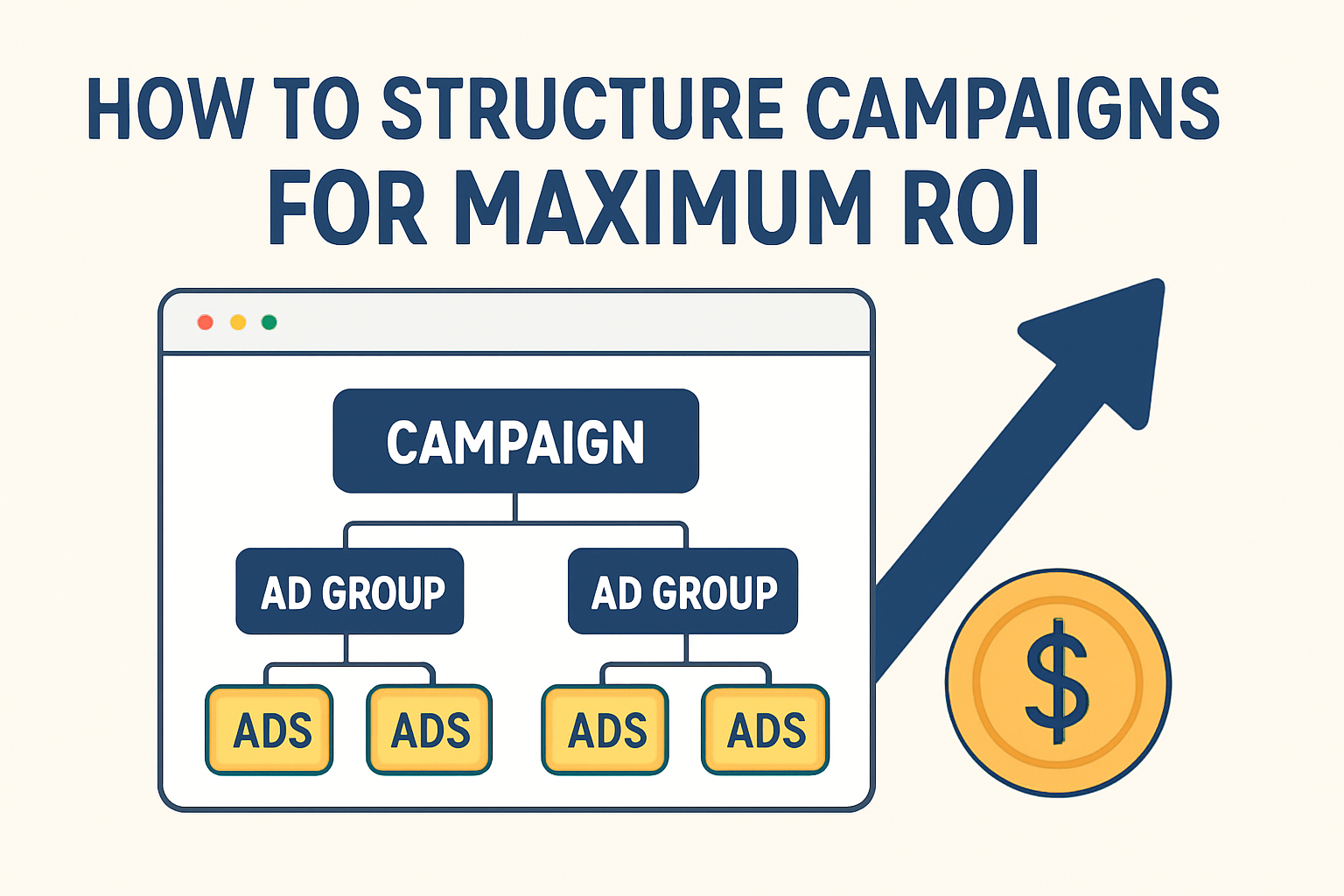
- Campaign – The top level. This decides your overall budget, location targeting, and big settings (like Search, Display, Video, etc.).
- Ad Groups – These sit inside campaigns. Each ad group contains related ads and keywords.
- Ads – These are the actual messages people see (text ads, image ads, or video ads).
- Keywords or Audience Targeting – The words, interests, or behaviors you want to target.
If you build these layers in an organized way, your campaigns become easier to control.
Step 1: Define Your Goals Clearly
Every campaign must start with a clear goal. Ask yourself:
- Do I want more sales?
- Do I want people to sign up for my newsletter?
- Do I want more phone calls?
- Do I just want brand awareness?
Your goal will shape everything else — from how you structure the campaign to what type of ads you use. For example:
- Sales Goal → Focus on conversion-based campaigns.
- Leads Goal → Optimize for form fills or calls.
- Awareness Goal → Use Display or Video campaigns to reach more people.
A campaign without a goal is like a car without a destination.
Step 2: Separate Campaigns by Objective
One of the best practices is to create different campaigns for different objectives. Do not mix everything in one place.
Example:
- Campaign 1: Sales in Pakistan.
- Campaign 2: Sales in UAE.
- Campaign 3: Brand Awareness in the Middle East.
This way, you can set separate budgets, measure results easily, and make clear decisions.
Step 3: Organize by Product or Service
If you sell different products, create separate campaigns or ad groups for each product line.
Example:
- Campaign A: Laptops
- Ad Group 1: Gaming Laptops
- Ad Group 2: Business Laptops
- Campaign B: Mobile Phones
- Ad Group 1: Android Phones
- Ad Group 2: iPhones
This structure makes sure your ads and keywords match exactly what people are searching for. When your ad matches the user’s intent, they are more likely to click and buy — which increases ROI.
Step 4: Use Tight Keyword Grouping
Inside each ad group, keep your keywords tightly related. Avoid mixing unrelated keywords.
Bad example:
- Ad Group: “Mixed Electronics” → Keywords: laptop, headphones, smartphone, TV
Good example:
- Ad Group: “Gaming Laptops” → Keywords: best gaming laptop, budget gaming laptop, gaming laptop price
When keywords and ads are highly related, Google gives you a better Quality Score, which means lower costs and higher ad positions.
Step 5: Write Relevant and Clear Ads
Your ad should directly match the user’s search or interest. If your ad group is about “gaming laptops,” then your ad should clearly mention gaming laptops — not just laptops in general.
Tips for writing effective ads:
- Include the keyword in the headline.
- Show a benefit (e.g., fast performance, affordable price).
- Add a call-to-action (e.g., “Buy Now,” “Shop Today,” “Get Free Demo”).
- Use ad extensions like site links, call extensions, or price extensions to provide extra information.
The closer the ad matches the user’s need, the higher your chances of conversion.
Step 6: Allocate Budget Smartly
Your budget should match your priorities. For example:
- If your top goal is sales, give more budget to conversion campaigns.
- If brand awareness is less important, keep a smaller budget there.
Pro Tip: Start small, test different campaigns, and then put more budget into the ones that perform the best. This reduces waste and improves ROI.
Step 7: Target the Right Audience
Google Ads gives you many targeting options:
- Location targeting – Show ads only in specific cities or countries.
- Device targeting – Focus on mobile or desktop.
- Demographics – Age, gender, income, etc.
- Custom audiences – Based on interests or website visitors.
For maximum ROI, avoid showing ads to people who are unlikely to buy. For example, if you sell high-end laptops, you might not want to target teenagers with limited budgets.
Step 8: Use Conversion Tracking
You cannot improve what you don’t measure. Set up conversion tracking so you know exactly which campaign, ad group, or keyword is bringing results.
Conversions can be:
- A purchase on your website.
- A form submission.
- A phone call.
- A download of your app.
Once tracking is in place, you can see where money is working and where it is wasted.
Step 9: Test and Optimize Regularly
Even the best campaign structure needs regular care. You should test different ads, keywords, and targeting options. This is called A/B testing.
For example:
- Test two different headlines to see which gets more clicks.
- Try a new landing page to check if it brings more conversions.
- Compare performance between mobile and desktop.
Optimization is a continuous process. The more you test, the higher your ROI will be.
Step 10: Keep Campaigns Simple and Clean
Many beginners make the mistake of creating too many campaigns and ad groups. Keep things simple. A clean structure is easier to manage and gives better results.
- Avoid duplicate keywords.
- Pause campaigns that do not perform.
- Merge ad groups if they are too small.
Remember, clarity always beats complexity.
Common Mistakes to Avoid
- Mixing different products in one ad group.
- Targeting all countries in one campaign without proper budget.
- Ignoring negative keywords (words you don’t want to trigger your ads).
- Not checking performance regularly.
- Writing general ads that do not match keywords.
Avoiding these mistakes will save you money and time.
Example of a Well-Structured Campaign
Let’s say you own an online store selling shoes. A good campaign structure would look like this:
- Campaign 1: Men’s Shoes (Pakistan)
- Ad Group 1: Men’s Formal Shoes
- Ad Group 2: Men’s Casual Shoes
- Ad Group 3: Men’s Sports Shoes
- Campaign 2: Women’s Shoes (Pakistan)
- Ad Group 1: Women’s Heels
- Ad Group 2: Women’s Flats
- Ad Group 3: Women’s Sports Shoes
Each ad group has its own set of related keywords and specific ads. Budgets are set based on which category sells more. Conversion tracking shows which shoe types bring the most profit. Over time, you increase budget on winning categories and reduce or pause weak ones. This is how you maximize ROI.
Final Thoughts
Structuring your campaigns in the right way is the backbone of successful online advertising. Without structure, your campaigns may waste money and bring poor results. With the right structure, you can:
- Target the right people.
- Deliver the right message.
- Spend money wisely.
- Track results properly.
- Grow your business with confidence.
Remember these golden rules:
- Start with clear goals.
- Separate campaigns by objectives and products.
- Keep ad groups tightly focused.
- Write relevant ads.
- Track and optimize regularly.