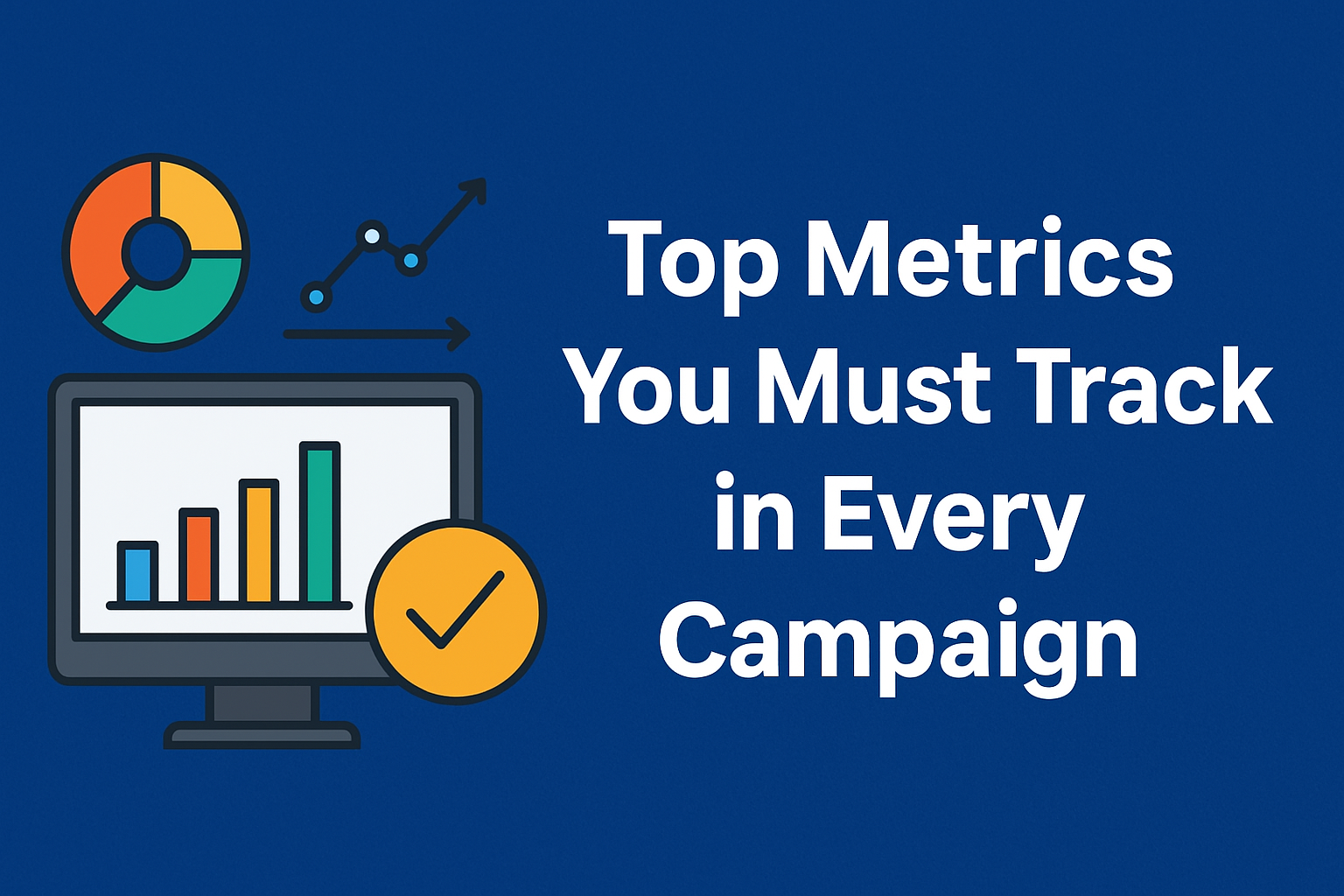
Running a marketing campaign without tracking the right metrics is like driving a car without looking at the dashboard. You may keep moving, but you won’t know if you are going in the right direction or wasting fuel. In digital marketing, metrics are the key indicators that tell you whether your efforts are paying off or not.
In this article, we will explain the top metrics you must track in every campaign. The goal is to make everything clear and simple so that even beginners can understand and apply these steps. By the end, you will know exactly which numbers to focus on, how to read them, and how they can help you grow your business.
Why Tracking Metrics Matters
Every campaign, whether it is run on Google Ads, Facebook, email, or any other platform, requires data. Without data, you are only guessing. Tracking metrics allows you to:
- Understand if your ads are reaching the right audience.
- See how people are reacting to your content.
- Compare results between different campaigns.
- Find out which strategy is giving you the best return on investment (ROI).
- Improve your future campaigns based on real results.
In short, metrics give you control over your marketing performance.
1. Click-Through Rate (CTR)
CTR shows how many people clicked on your ad after seeing it. It is one of the most important metrics to measure the success of your campaign.
Why it matters:
A high CTR means your ad is relevant and attractive to your audience. A low CTR signals that you may need to improve your ad copy, image, or targeting.
How to improve CTR:
- Use clear and catchy headlines.
- Add a strong call-to-action (CTA).
- Test different ad formats.
- Target the right audience segment.
For example, if your ad was shown 1,000 times and 50 people clicked, your CTR is 5%.
2. Conversion Rate (CR)
Getting clicks is not enough. The real success of your campaign depends on how many people take the desired action, such as signing up, buying a product, or downloading an app. That’s what the conversion rate measures.
Why it matters:
A high conversion rate shows that your landing page and offer are working well. A low rate may mean there is an issue with your website, pricing, or message.
How to improve conversion rate:
- Keep landing pages simple and focused.
- Make the buying process easy.
- Use testimonials or trust signals.
- Match your ad promise with the landing page.
3. Cost Per Click (CPC)
CPC tells you how much you are paying for each click on your ad.
Why it matters:
Even if your ads are performing well, a very high CPC can hurt your budget. Lower CPC means you are getting more traffic for less money.
Tips to reduce CPC:
- Improve ad relevance.
- Use long-tail keywords.
- A/B test different ad creatives.
- Focus on quality score (for Google Ads).
4. Return on Ad Spend (ROAS)
ROAS measures how much revenue you earn for every dollar spent on ads.
Why it matters:
This metric directly shows the profitability of your campaign. For example, if you spent $100 and earned $400 in sales, your ROAS is 4:1.
How to improve ROAS:
- Focus on high-value customers.
- Use retargeting to reach interested users.
- Optimize ad placements.
- Track revenue carefully across all channels.
5. Cost Per Acquisition (CPA)
CPA is the average cost to acquire one customer. It can be higher than CPC because not every click leads to a conversion.
Why it matters:
It shows the true cost of gaining new customers. A lower CPA means your campaign is cost-effective.
Ways to reduce CPA:
- Improve targeting accuracy.
- Create strong retargeting ads.
- Use offers, discounts, or bundles.
- Test and refine your landing pages.
6. Impressions and Reach
These two metrics show how many times your ad is seen (impressions) and how many unique people saw it (reach).
Why it matters:
High impressions with low engagement may mean your ads are not appealing. Good reach ensures you are not wasting money showing ads to the same people too many times.
Best practices:
- Balance frequency so users are not bored by repeated ads.
- Focus on quality, not just quantity of views.
7. Bounce Rate
Bounce rate tells you how many visitors leave your landing page without taking any action.
Why it matters:
If your bounce rate is high, it means people are not finding your page relevant or user-friendly.
How to lower bounce rate:
- Make landing pages load faster.
- Ensure content matches ad promises.
- Improve page design and readability.
- Use mobile-friendly layouts.
8. Engagement Rate
Engagement rate measures how actively people interact with your ads or content. This includes likes, comments, shares, and clicks.
Why it matters:
High engagement means your message is connecting with your audience. This can increase trust and brand loyalty.
How to boost engagement:
- Post content that solves real problems.
- Ask questions or encourage comments.
- Use visuals like images and videos.
- Reply to user interactions.
9. Lifetime Value (LTV)
LTV is the total revenue you expect from a customer during their entire relationship with your brand.
Why it matters:
Knowing LTV helps you understand how much you can afford to spend to acquire a customer. If your LTV is higher than your CPA, you are in profit.
Tips to increase LTV:
- Offer subscriptions or repeat purchase options.
- Provide excellent customer support.
- Use loyalty programs.
- Upsell and cross-sell related products.
10. Customer Retention Rate
Retention rate measures how many customers keep buying from you over time.
Why it matters:
Keeping old customers is often cheaper than acquiring new ones. A good retention rate also increases LTV.
Ways to improve retention:
- Send follow-up emails.
- Offer rewards or discounts.
- Provide consistent value.
- Build strong relationships through personalized marketing.
11. Return on Investment (ROI)
ROI is the overall measure of your campaign’s profitability. It considers both ad spend and all other costs.
Why it matters:
It shows whether your campaign is truly adding value to your business or just generating traffic without profit.
Formula:
ROI = (Profit – Cost) ÷ Cost × 100%
For example, if you spent $1,000 and earned $1,500, your ROI is 50%.
Putting It All Together
Tracking these metrics is not about collecting numbers just for the sake of it. It is about using the data to make smarter decisions. Here is how you can combine them:
- Use CTR and engagement rate to measure interest.
- Track conversion rate and CPA to measure effectiveness.
- Focus on ROAS, LTV, and ROI to measure profitability.
- Monitor bounce rate, reach, and retention to improve long-term results.
Final Thoughts
Every campaign is unique, but the success always depends on how well you track and understand the numbers behind it. By focusing on the metrics explained above, you can avoid wasting money, improve customer experience, and achieve higher profits.
The key is not to be overwhelmed. Start with a few important metrics like CTR, conversion rate, and ROAS. Once you are comfortable, add more advanced ones like LTV and retention rate. Over time, your campaigns will become smarter, stronger, and more profitable.
If you want your campaigns to grow, track, test, and improve continuously. Numbers never lie, and when used correctly, they can guide you toward lasting success.