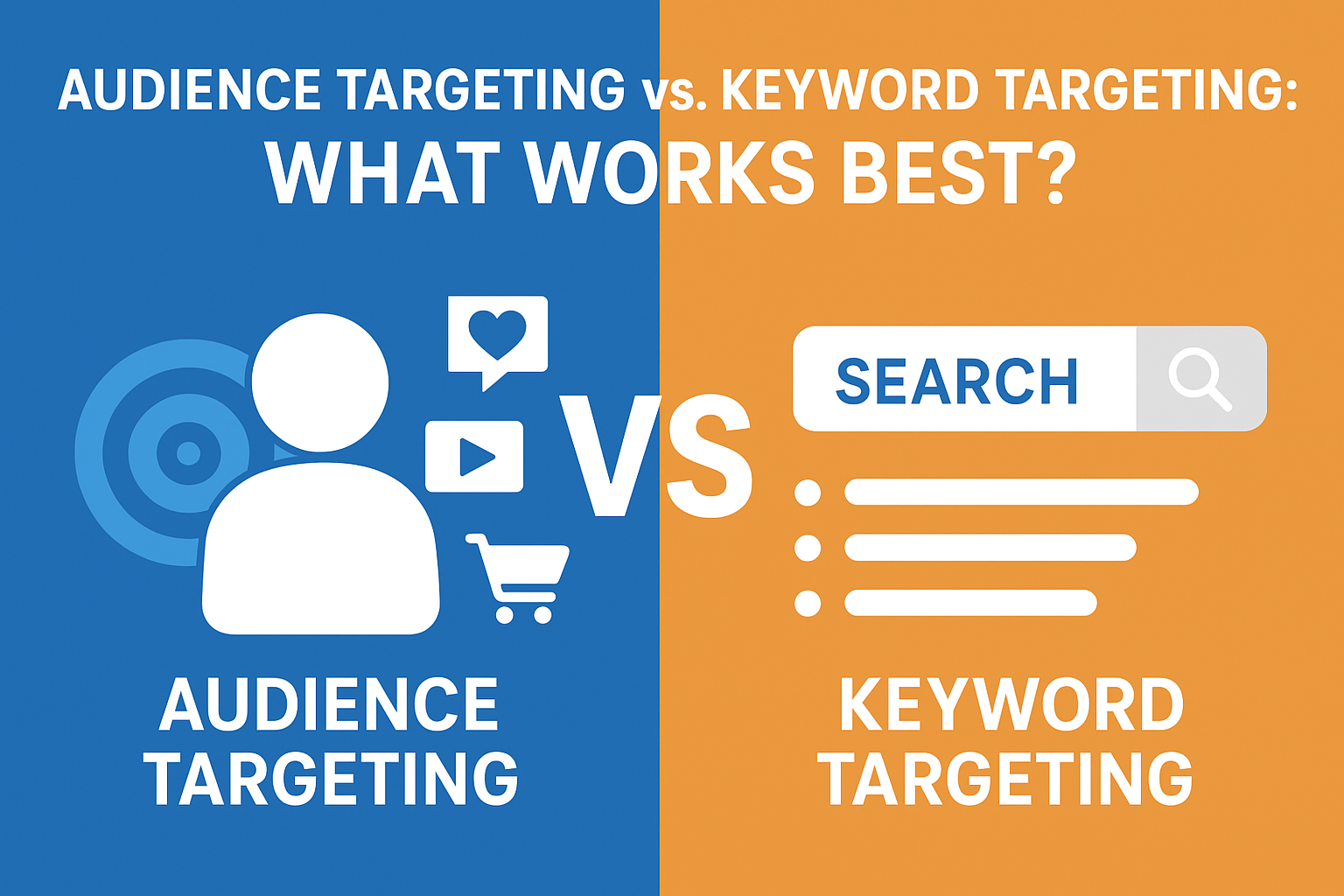
When it comes to digital marketing, advertisers are always looking for the best way to reach the right people. Two of the most common methods are audience targeting and keyword targeting. Both approaches have their own benefits, and both can help you reach your marketing goals. But the big question is: which one works best for your business?
In this blog, we will explore both strategies in depth, look at their pros and cons, and finally help you decide which method (or mix of both) will work best for your campaigns.
What is Audience Targeting?
Audience targeting means showing your ads to a group of people based on their interests, behaviors, demographics, or online activities. Instead of focusing on words typed into a search engine, you focus on who the person is.
For example:
- If someone often reads articles about fitness and healthy eating, they may fall into a “fitness enthusiast” audience group.
- If someone recently searched for flight tickets, they may be put in a “travel intention” audience.
In simple terms, audience targeting is like saying: “I want my ad to be shown to people who are likely interested in my product, based on their online behavior.”
Types of Audience Targeting
Audience targeting comes in different forms. Some of the most common include:
- Demographic Targeting
Target people based on their age, gender, income, education level, or marital status. For example, an insurance company may want to show ads to adults over 30. - Interest-Based Targeting
Show ads to people interested in topics like travel, sports, technology, or beauty. - Behavioral Targeting
Reach people based on actions they take online, such as visiting a website, adding items to cart, or watching specific videos. - Custom Audiences
Upload customer data (like emails or phone numbers) to reach your existing audience. - Lookalike or Similar Audiences
Reach people who share similar behaviors and interests with your current customers.
Benefits of Audience Targeting
- Precision: You reach people most likely to buy from you.
- Higher Engagement: Ads become more relevant, leading to better click-through rates.
- Strong Brand Awareness: Helps introduce your brand to people who may not be searching for your product yet.
- Personalization: Allows you to tailor messages to specific groups.
Limitations of Audience Targeting
- Smaller Reach: Sometimes, targeting can limit how many people see your ad.
- Costly: Narrow targeting can make ads more expensive per click or per impression.
- Data Dependency: Requires accurate audience data; without it, performance can suffer.
What is Keyword Targeting?
Keyword targeting means showing your ads to people who type specific words or phrases into search engines. Here, the focus is not on who the user is, but what they are searching for.
For example:
- A person types “buy running shoes online.” If you sell shoes and target that keyword, your ad can appear.
- Someone searches “best coffee shop near me.” A local café can use keyword targeting to show up at the right time.
This method is like saying: “I want my ad to appear when someone is actively searching for what I offer.”
Types of Keyword Targeting
Keyword targeting also has several types:
- Broad Match
Ads show for searches that relate to your keyword, even if the exact words are not used. - Phrase Match
Ads appear for searches that include your keyword phrase in the same order. - Exact Match
Ads only show when the search matches your keyword exactly. - Negative Keywords
Exclude your ads from searches that are not relevant. For example, if you sell “luxury watches,” you might exclude the keyword “cheap watches.”
Benefits of Keyword Targeting
- High Intent: People searching for keywords often want to buy or learn about the product right now.
- Wide Reach: Can attract new customers who may not know your brand.
- Budget Control: You can bid only on keywords that fit your goals.
- Measurable Results: Easy to track which keywords bring sales or leads.
Limitations of Keyword Targeting
- Competition: Popular keywords can be very expensive.
- Irrelevant Clicks: Ads may show for unrelated searches, wasting money.
- Requires Constant Management: Keywords need updating, removing, or adding based on performance.
- Short-Term Impact: Works well when people search, but not as strong for brand building.
Audience Targeting vs. Keyword Targeting: Key Differences
| Factor | Audience Targeting | Keyword Targeting |
|---|---|---|
| Focus | Who the person is | What the person searches |
| Timing | Shows ads even if user is not searching | Only when user types keywords |
| Goal | Build brand awareness, remarketing | Capture immediate intent |
| Reach | Narrow but focused | Broad but may be less precise |
| Cost | Can be higher for niche audiences | Can be higher for competitive keywords |
| Best For | Long-term relationship building | Direct conversions |
Which One Works Best?
The answer is: It depends on your goals. Let’s break it down:
When to Use Audience Targeting
- You want to build brand awareness.
- You want to re-engage past visitors (remarketing).
- You sell products that people don’t search often, but are interested in (e.g., luxury items, niche hobbies).
- You want to reach new people who are similar to your best customers.
When to Use Keyword Targeting
- You want fast results and immediate conversions.
- You have a clear list of keywords your customers use.
- You want to target people with high buying intent.
- You want measurable ROI from specific search terms.
The Power of Combining Both
In today’s marketing world, using only one method can limit your success. The most effective campaigns often use both audience and keyword targeting together.
Here’s how you can combine them:
- Start with keyword targeting to capture active searches.
- Add audience targeting to retarget visitors who didn’t convert.
- Layer audience data on keywords to show ads only to people most likely to buy.
- Test different mixes to see which gives the best ROI.
For example, if someone searches “best laptops for students” and they also fall into an audience interested in technology, your ad will be highly relevant and more likely to perform well.
Practical Tips for Success
- Know Your Business Goals
Decide if your aim is awareness, sales, or lead generation. This will help you choose the right targeting method. - Start Small and Test
Don’t spend your full budget at once. Test both methods with smaller budgets and track performance. - Use Analytics Tools
Google Ads and other platforms provide data about clicks, impressions, and conversions. Study these reports carefully. - Refine Over Time
Remove keywords or audiences that don’t work. Add new ones based on data. - Balance Budget
Don’t put all your money into one method. A mix usually brings the best results.
Final Thoughts
Audience targeting and keyword targeting are two powerful tools in digital advertising. Both have unique strengths and weaknesses. Audience targeting helps you build brand awareness and reach people based on their interests and behavior, while keyword targeting captures immediate buying intent when users are actively searching.
So, which one works best? The truth is that the best strategy is often a blend of both. By using them together, you can reach new people, engage potential customers, and drive conversions—all while staying within your budget.
In the end, your choice should depend on your goals, your product, and your audience. If you want long-term brand growth, lean more on audience targeting. If you want instant sales, keyword targeting is your best bet. And if you want the strongest results, combine both strategies smartly.